
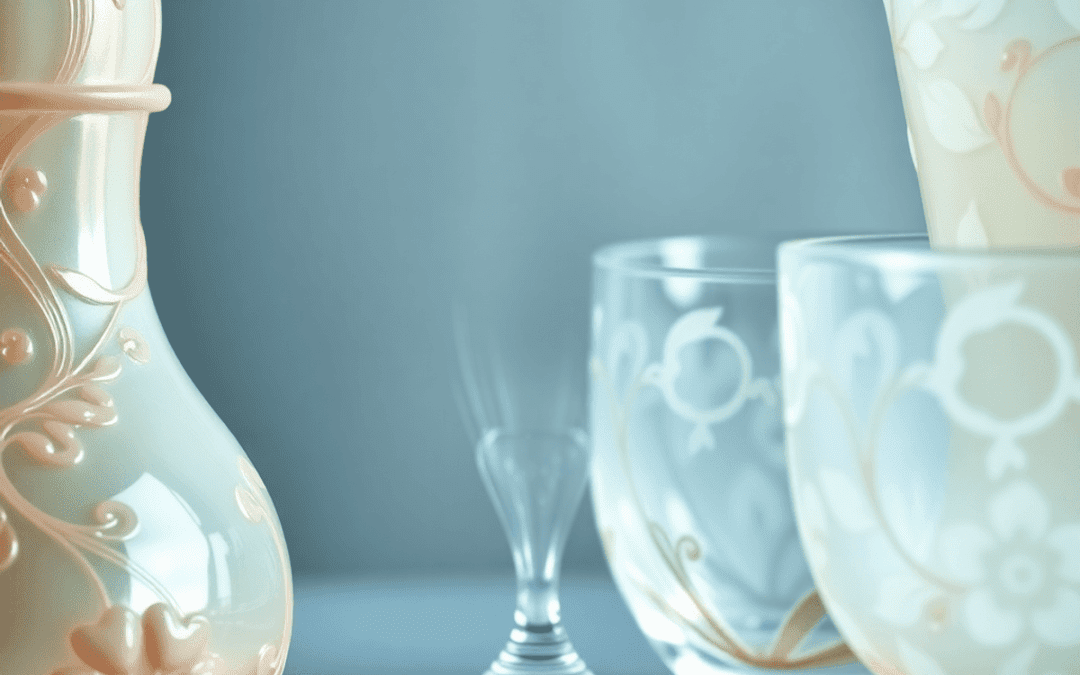
If you have ever stopped in front of a piece of glass and felt yourself oddly pulled in, you are not alone. Great Art Nouveau glass has that effect. It does not shout. It glows. It shimmers. It seems to hold light the way a pond holds the sky, and once you start noticing it, you begin seeing it everywhere: in the curve of an iris on a vase, in a dragonfly wing caught in relief, in a wash of colour that looks like mist at sunrise.
Collecting Art Nouveau glass is one of the most satisfying ways to get close to the decorative arts. You can hold it, turn it, watch it change under different light, and slowly train your eye to recognise what makes a piece special. This guide is for beginners who want to start confidently, avoid common mistakes, and build a collection they genuinely love.
What “Art Nouveau glass” actually means
Art Nouveau, a design movement that flourished roughly from the 1890s to the early 1910s, embraced nature, movement, asymmetry, and craftsmanship. In glass, that translated into organic shapes, plant and insect motifs, sinuous lines, and technical experimentation that still feels daring today.
When people say “Art Nouveau glass”, they usually mean glass made during the period and in the style of the movement. You will also hear terms like:
- Art Nouveau period: made during the era (roughly 1890 to 1914).
- Art Nouveau style: made later but using the same visual language.
- Art glass: a broader category that includes Nouveau, Art Deco, and later studio glass.
As a collector, it helps to be clear with yourself. Do you want period pieces only, or are you happy to include later works that capture the spirit? There is no wrong answer, but your budget and your research approach will change depending on it.
For instance, if you’re interested in buying Art glass, it’s crucial to understand the nuances between different types such as Kralik glass or Pallme König glass. Each type has its unique characteristics and history which could significantly influence your purchasing decisions.
Moreover, if you’re captivated by specific pieces like Kralik coral vases, understanding their background can enhance your appreciation and help you make informed choices while collecting.
Why Art Nouveau glass is so collectable
Three things make this area especially rewarding:
- The variety is enormous. You can collect delicately enamelled cabinet vases, bold sculptural forms, lamps, bottles, bowls, scent flacons, and everyday table glass that still carries Nouveau curves. For instance, the Kralik snakeskin vase, which showcases the unique texture and design that Kralik glass is known for.
- The techniques are fascinating. Iridescence, acid-etching, cameo carving, internal decoration, and layered colour were pushed hard during this period.
- You can start small and still buy something real. Not everything is museum-level pricing. With patience, you can find honest pieces at accessible levels, especially if you focus on less famous makers or simpler forms.
The key styles and techniques you’ll see (and learn to spot)
You do not need to memorise a textbook, but understanding a few hallmark techniques will help you judge quality quickly.
Iridescent glass
This is the shimmering, oil-on-water effect often associated with makers like Loetz and Tiffany, but also seen elsewhere. The iridescence is usually created by metallic salts applied to hot glass, producing colour shifts under light.
Beginner tip: Iridescence should look integrated, not sprayed-on. Harsh, uniform rainbow sheens can be a red flag for later decorative finishes or reproductions.
Cameo glass
Cameo glass is typically layered (often two or more colours) and then carved or acid-etched so the upper layer forms a design in relief. It can be exquisitely detailed: flowers, landscapes, vines, even figurative scenes.
Beginner tip: Run your eye along the edges of the carved design. Quality cameo tends to have crisp modelling and intentional depth, not a shallow, fuzzy outline.
Examples of Kralik Glass
Kralik glass provides an excellent example of the variety and technique found in Art Nouveau glassware. The Wilhelm Kralik vase showcases the intricate designs that define this style. Similarly, the Kralik bacillus bowl exemplifies unique form and function with its distinctive shape and design.
For collectors interested in more sculptural forms, the Wilhelm Kralik tri-footed amphora vase offers a stunning example of Kralik’s bold approach to form. Additionally, the Rindskopf vase represents another facet of Art Nouveau glass with its unique style and craftsmanship.
Acid-etched and engraved decoration
Acid-etching can create matte surfaces, soft transitions, and stylised patterns. Engraving can be fine and precise. Many factories used a combination of techniques, sometimes with gilding or enamel.
Beginner tip: Look for confident design. Even simple patterns should feel purposeful and well-placed on the form.
Moulded and pressed forms
Not all Art Nouveau glass is “art glass” in the expensive sense. Pressed and moulded glass can still be beautifully designed, and it was part of how the style reached ordinary homes.
Beginner tip: Learn to love honest pressed glass. It is often the best entry point, and you will develop your eye for silhouettes and motifs without paying for rarities.
Applied decoration and metal mounts
Some pieces have applied trails, prunts, or handles. Others come with Ormolu or bronzed mounts, especially vases and lamps.
Beginner tip: Mounts can add value, but they can also hide damage at the rim. Always inspect where metal meets glass.
The makers beginners should know (without getting overwhelmed)
You do not have to collect by maker, but names help you navigate listings and prices. Here are a few you will encounter often:
- Émile Gallé (France): a giant of the movement. Known for poetic naturalism, marquetry-like effects in glass, and cameo work. Widely copied and widely faked, so research matters.
- Daum Nancy (France): exquisite cameo and enamel, often with rich colour. Many pieces are signed, but signatures vary.
- Loetz (Bohemia, now Czech Republic): famous for iridescent “Phenomen” decors and flowing organic shapes. You can learn more about Loetz glass here.
- Tiffany Studios (USA): lustre glass and iconic forms. Highly collected, with corresponding prices and reproductions.
- WMF (Germany): more known for metalwork, but important for Nouveau design and mounted glass.
- British names to watch: Stevens & Williams (and related Stourbridge firms), Thomas Webb (including cameo), and other Stourbridge-area glassmakers who produced Nouveau-influenced work.
A healthy beginner approach is to pick one or two areas to focus on at first: perhaps French cameo, Bohemian iridescence like the exquisite pieces from Kralik, or British Stourbridge pieces such as those from Josef Rindskopf or Wilhelm Kralik. A focus keeps your learning curve enjoyable rather than chaotic.
How to choose your first pieces (the fun part)
The best starter collection is not the one that looks impressive on day one. It is the one that makes you want to keep learning.
Here are practical ways to choose early purchases:
Start with form before decoration
In Art Nouveau, the silhouette is everything. A great shape can carry minimal decoration and still feel alive.
When you look at a piece, ask:
- Does the profile feel elegant from multiple angles?
- Is the neck in proportion to the body?
- Does it look static, or does it feel like it is moving?
Buy the best condition you can afford
Minor wear is normal. Big repairs are not “normal”, even if sellers try to reassure you. Condition affects value, and it affects your enjoyment.
For beginners, I recommend prioritising:
- No cracks
- No significant chips, especially on rims and feet
- No obvious glued repairs
- No heavy scratches that dull the surface
Let colour guide you (but do not be blinded by it)
Art Nouveau glass often leans into moody, botanical palettes: olives, ambers, smoky purples, petrol blues, and creamy opalescence. Choose colours you genuinely want to live with. Your collection will spend most of its life on a shelf, not in an auction catalogue.
Expect to “pay tuition”
Everyone who collects pays a little tuition at the start: an impulse buy that turns out to be later than expected, a piece with an unnoticed rim nibble, a pattern you later realise is common. That is fine. Just keep the stakes sensible while you are learning.
How to spot signatures, marks, and labels (and how much to trust them)
Marks can help, but they are not the whole story.
- Acid-etched signatures can be original, but they can also be added later.
- Engraved signatures are often more convincing, though still not foolproof.
- Paper labels are wonderful when genuine, but many do not survive a century, and some are replaced.
A good habit is to judge the piece first, then treat the signature as supporting evidence, not the main proof.
If you are buying online, request:
- A close photo of the mark in raking light (angled light reveals engraving depth)
- A photo of the base, side-on, so you can see wear
- A photo of the rim and foot
Reproductions, “in the style of”, and common beginner traps
The market is full of pieces described as “Nouveau style”, “in the manner of”, or simply mislabelled. Some are honest decorative glass like this Pallme Konig shade, while others are deliberate fakes.
Watch for these issues:
Too-perfect uniformity
Art Nouveau glass, even factory-made, often shows subtle variation. If something looks overly uniform, with a decoration that feels printed rather than crafted, be cautious.
Suspiciously strong colours and finishes
Bright, hard neon colours and harsh surface sheens can indicate later production. Period pieces can be vivid, but the colour usually has depth.
Over-reliance on a famous name
Listings that scream “GALLÉ!” but show only one blurry photo of a generic floral vase are a classic trap. Buy the object, not the excitement.
Damage hidden by photography
Soft focus, dark lighting, or photos that avoid the rim and base often mean “there is something they do not want you to see”.
Where to buy Art Nouveau glass (and what each place is best for)
Auction houses (online and local)
Auctions can be brilliant, especially for learning. Even if you do not bid, you can watch prices and compare similar forms.
- Pros: potential value, wide variety, useful catalogues
- Cons: buyer’s premium, limited returns, condition can be tricky
Antique shops and fairs
You pay a little more, but you gain something important: handling time. The more you handle glass, the faster your eye develops.
- Pros: you can inspect in person, build relationships with dealers
- Cons: stock can be uneven, pricing varies
Online marketplaces
Convenient and sometimes full of surprises, but you must be disciplined.
- Pros: huge selection, easy to compare
- Cons: misattribution, hidden damage, inconsistent expertise
If you buy online, set yourself a rule: no purchase without clear rim, base, and side photos.
Specialist dealers
A good specialist dealer is not just selling objects. They are offering judgement, sourcing, and usually a return policy.
- Pros: higher confidence, better descriptions, often vetted authenticity
- Cons: higher prices, fewer “bargains”
A simple checklist for viewing a piece in person
If you can inspect a piece, do this in order:
- Look at the silhouette first. Do you love the shape?
- Check the rim with your fingertips for nibbles or chips.
- Check the foot for chips and grinding marks.
- Hold it up to light to reveal cracks, cloudiness, or internal issues.
- Look for repairs: glue lines, mismatched shine, over-polished areas.
- Assess decoration quality: crispness, depth, intentional placement.
- Only then check the mark and compare it to known examples.
It sounds methodical, but it quickly becomes second nature, and it saves you from expensive disappointment.
How to build a collection that feels coherent (even if you buy eclectic pieces)
Some collectors chase one maker. Others collect a theme. Both approaches can work.
Here are a few beginner-friendly “collection angles”:
- Botanical motifs: irises, orchids, poppies, wisteria
- Insects and aquatic life: dragonflies, beetles, fish, seaweed forms
- A single technique: cameo only, iridescent only, acid-etched only
- A single colour family: smoky greens and ambers, or opalescent whites
- Functional forms: only vases, only bowls, only scent bottles
A coherent collection does not have to be matchy. It just needs a point of view.
For those interested in the unique charm of Art Nouveau glass vases, consider exploring the beautiful Rindskopf marbled vases or the exquisite Josef Rindskopf vases. These pieces can add a distinctive touch to any collection.
Display, lighting, and care (so your glass actually looks its best)
Art Nouveau glass is a dance between material and light. Display matters more than people think.
Lighting
- Natural light is beautiful, but avoid direct sun for long periods, especially with labels or delicate surface decoration.
- A small, warm spotlight or LED strip in a cabinet can bring iridescence and layering to life.
- Move pieces occasionally and watch how they change. It is part of the pleasure.
Cleaning
- Wash gently with mild soap and lukewarm water if needed.
- Avoid harsh chemicals, abrasives, and dishwasher heat.
- Be cautious with pieces that have gilt, enamel, or metal mounts.
Handling
Hold by the body, not the rim, not the handle, and not the neck alone. Many elegant Nouveau shapes are structurally delicate exactly where they look most tempting to grip.
What you should pay (and how to think about value as a beginner)
Prices vary wildly depending on maker, rarity, technique, size, and condition. Rather than chasing a universal price guide, focus on building your own reference points:
- Save sold listings from auctions.
- Note dimensions, condition, and any marks.
- Compare like with like. A small signed cameo vase and a large mounted example are not in the same universe.
Most importantly, do not let “investment talk” drown out the real reason to collect. Art Nouveau glass is a daily, visual pleasure. If you buy what you love, with good judgement and decent condition, value tends to look after itself better than people expect.
A beginner’s buying plan you can actually follow
If you want a simple roadmap:
- Choose one focus for your first three purchases (maker, technique, motif, or colour).
- Buy one affordable “study piece” that you can handle without fear. Pressed glass or a modest unsigned piece is perfect.
- Buy one piece for craftsmanship: better finish, better design, even if smaller.
- Buy one piece for pure joy: the one you keep thinking about.
For instance, a Rindskopf Snake Vase could serve as an affordable study piece due to its unique design yet reasonable price point. Then you might consider investing in a Pallme Konig Vase for its superior craftsmanship.
By the time you do that, you will have learned more than any number of hours scrolling listings.
Let’s wrap up
Collecting Art Nouveau glass is not about rushing towards the “best” pieces. It is about training your eye, learning the language of form and technique, and slowly filling your space with objects that feel alive in the light.
Start with what you can afford, insist on good condition, treat signatures as clues rather than guarantees, and keep your focus simple until your confidence grows. If you do that, your collection will not just look beautiful. It will tell the story of your taste getting sharper, one glowing piece at a time.
As you progress in your collection journey, don’t shy away from exploring unique pieces such as the Wilhelm Kralik Sea Urchin Vase or the Kralik Martele Teardrop Vase. Each piece has its own story to tell and adds to the richness of your collection.
FAQs (Frequently Asked Questions)
What defines Art Nouveau glass and its significance in decorative arts?
Art Nouveau glass refers to glassware made during the Art Nouveau period (roughly 1890 to 1914) or later pieces created in the same style, characterised by organic shapes, plant and insect motifs, sinuous lines, and innovative craftsmanship. It holds a special place in decorative arts for its glowing, shimmering quality that captures light beautifully, making it highly collectible and visually captivating.
Why is collecting Art Nouveau glass considered rewarding for beginners?
Collecting Art Nouveau glass is rewarding due to the enormous variety available—from enamelled vases to sculptural lamps—and the fascinating techniques like iridescence and cameo carving employed. Moreover, beginners can start with affordable pieces from lesser-known makers or simpler forms, allowing them to build a genuine collection without museum-level pricing.
What are the hallmark techniques used in Art Nouveau glass that collectors should recognise?
Key techniques include iridescent glass, which features a shimmering colour-shift effect created by metallic salts on hot glass; and cameo glass, which involves layering coloured glass and carving or acid-etching designs in relief. Recognising integrated iridescence and crisp modelling in cameo work helps judge authenticity and quality.
How can one distinguish authentic iridescent Art Nouveau glass from later reproductions?
Authentic iridescent Art Nouveau glass shows an integrated shimmer with subtle colour shifts under light, not a harsh or uniform rainbow sheen. Later decorative finishes or reproductions often have sprayed-on effects that lack depth and natural blending seen in original works by makers like Loetz and Tiffany.
What role does Kralik glass play in the context of Art Nouveau collecting?
Kralik glass exemplifies the variety and technical innovation of Art Nouveau glassware. Pieces like the Kralik snakeskin vase or tri-footed amphora vase showcase unique textures, bold forms, and intricate designs that are highly valued by collectors seeking authentic period examples with distinctive character.
Should collectors focus only on period pieces or include later works in the Art Nouveau style?
Collectors can choose based on personal preference: some focus solely on period pieces made between 1890-1914 for historical authenticity, while others include later works that capture the spirit of Art Nouveau. This decision affects budget considerations and research approaches but there is no wrong answer—both paths offer enriching collecting experiences.