
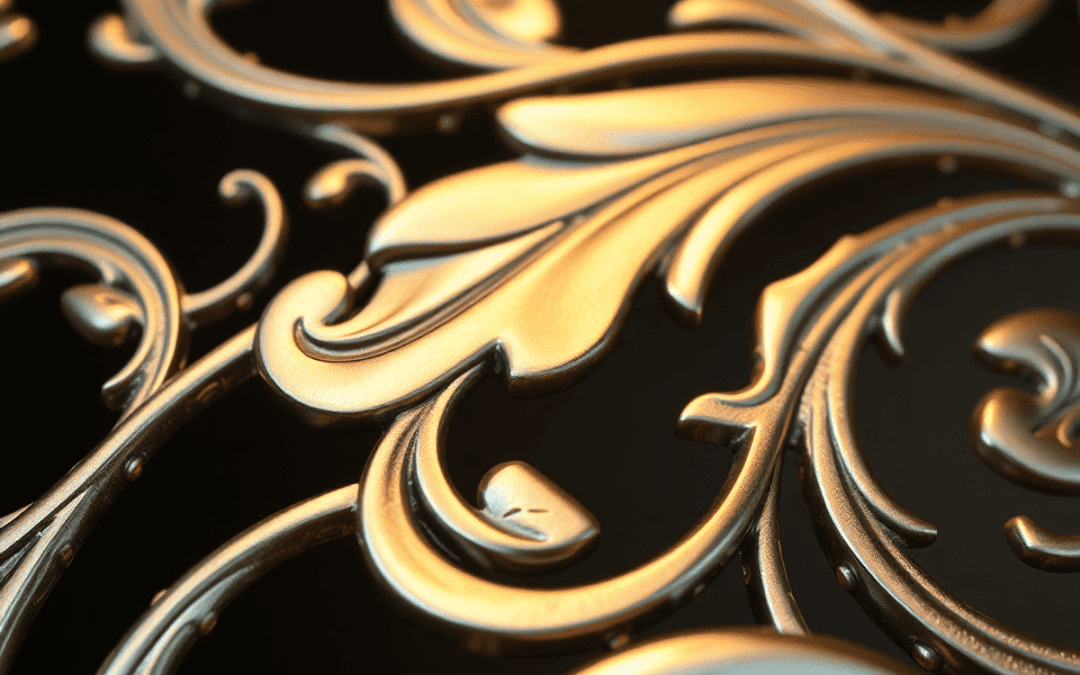
If you’ve ever picked up a piece of early 20th-century metalwork and felt it move in your hands, not literally, but emotionally, you’ll know what I mean when I say Art Nouveau is less a style and more a kind of living line.
It curls, it stretches, it pauses, it surprises you. It turns a practical object into something that feels like it grew rather than got manufactured.
And in the middle of that story, two names matter far more than most people realise: Archibald Knox and WMF. One was a quietly radical designer from the Isle of Man whose creations like the tulip vase, pewter enamel cake basket, cake tray, and Tudric tea set exemplify the essence of Art Nouveau. The other was a German industrial powerhouse capable of turning modern design into real objects at scale.
They didn’t “collaborate” in the usual way, and they weren’t part of the same company, but together they reveal the real secret of Art Nouveau metalwork: it wasn’t just about ornament. It was about reimagining what metal could be.
Art Nouveau metalwork: why it resonated
Art Nouveau arrived at exactly the right moment. The late 19th century had both new technologies and new anxieties.
Industry could produce almost anything, quickly, but much of what it produced felt soulless. At the same time, artists and designers were looking for a modern language that wasn’t borrowed from the past, not Gothic, not Classical, not a recycling of old motifs.
So the makers of Art Nouveau went looking elsewhere: plants, waves, wind, insects, seedpods, whiplash curves. They wanted forms that felt continuous and alive.
Metal was perfect for that. It could be:
- Drawn thin and elegant, like a stem or tendril
- Cast into relief, like a leaf pressing itself into the surface
- Hammered and shaped, so it caught light like water
When Art Nouveau metalwork is good, it’s not “decorated”. It’s composed. The structure and the pattern feel like the same thought.
And that’s exactly where Archibald Knox comes in. His works in Art Nouveau metalwork are prime examples of this unique blend of structure and pattern.
Archibald Knox: the designer who made line feel inevitable
Archibald Knox (1864–1933) is often introduced as a “Celtic” designer, and yes, Celtic ornament is part of his vocabulary. But that label is too small for what he did.
Knox was Manx, trained as a designer, and deeply sensitive to pattern as a system, not just as surface prettiness. His work has a kind of disciplined poetry to it.
Where some Art Nouveau designers went for lush, almost theatrical naturalism, Knox often went for something cleaner and more structural:
- Lines that interlace with logic, like well-made music
- Motifs that feel symbolic rather than illustrative
- Shapes that sit calmly in the hand
He became most famous through his work for Liberty & Co. in London, particularly the Cymric (silver and gold) and Tudric (pewter) ranges launched around the turn of the century.
These Liberty ranges mattered for one big reason: they proved that modern design could live in ordinary homes. Not as museum pieces, but as candleholders, clocks, boxes, jewellery, and tableware.
Knox’s best designs feel timeless because they balance two opposing energies:
- The ancient: knotwork, symmetry, ritual-like pattern
- The modern: restraint, clarity, purpose, repeatable form
That balance is also a useful lens for understanding WMF.
WMF: the industrial engine of Jugendstil metalwork
WMF stands for Württembergische Metallwarenfabrik, a German metalware manufacturer based in Geislingen. By the late 19th and early 20th centuries, WMF wasn’t just a successful company. It was a design machine.
WMF is crucial to the Art Nouveau story because it sat at the junction of:
- Artistic ambition
- Technical innovation
- Mass production
In Germany, Art Nouveau was often called Jugendstil, named after the magazine Jugend. Jugendstil could be curvilinear and floral, but it also had a taste for geometry and abstraction that sometimes feels like an early whisper of Art Deco.
WMF produced everything from cutlery to monumental centrepieces, from inkwells to claret jugs like this WMF claret jug, and it did so using advanced processes of casting, stamping, spinning, and plating.
Perhaps most importantly for collectors, WMF became famous for silver-plated wares and for a spectacular finishing technique called IKORA (introduced slightly later, in the 1920s), but even in the pure Art Nouveau years, the firm had a talent for surface.
Their objects often have an almost liquid sheen, and they used contrast—bright and matte, smooth and textured—to make the line read from across a room. This can be seen in various items such as their fruit stands or card trays, which are perfect examples of their craftsmanship. Furthermore, their wall plaques or visiting card trays.
So where does Knox meet WMF?
Let’s be precise: Archibald Knox is not known to have designed for WMF in the way he designed for Liberty & Co. Knox’s documented work sits firmly in the Liberty world, alongside the broader British Arts and Crafts context, even when his line becomes distinctly Art Nouveau.
So why put Knox and WMF in the same story?
Because they represent two halves of the same Art Nouveau metalwork miracle:
- Knox shows what happens when a single designer’s mind shapes a whole language of objects.
- WMF shows what happens when industry decides that design matters enough to invest in it properly.
If you love Art Nouveau metalwork, you end up admiring both approaches.
And the more you study them side by side, the more you notice something fascinating: their best pieces share the same core beliefs.
1) Line is the main character
Knox’s line often behaves like structured braid or controlled growth. For instance, a Knox clock case in Tudric pewter showcases how the line acts like architecture. On the other hand, WMF’s Jugendstil line is frequently more botanical, more flamboyant, but the idea is the same.
Look at a Knox candlestick or candleholder and you’ll see this principle in action. On both sides, the line isn’t just an outline. It’s an organising force.
2) Surface is not separate from form
One of the easiest ways to spot weaker decorative metalwork is when the ornament looks “stuck on”. Knox rarely lets that happen. His patterns wrap and anchor themselves to the object’s structure. For example, his silver vases often exemplify this integration.
WMF, for all its industrial power, often achieves a similar effect: relief patterns that grow naturally out of the body, handles that feel like extensions rather than attachments, feet and bases that echo the rhythm above.
3) Modern design can be domestic
This might be the biggest shared legacy.
Knox helped Liberty sell modern objects to a British public that wanted beauty but also practicality. WMF brought modern design into cafés, dining rooms, and middle-class homes across Europe.
These weren’t one-off showpieces. They were objects meant to be used, cleaned, carried, filled, poured, lit, and passed on.
And because of that, they still speak to us now.
Pewter, silver plate, and the pleasure of honest materials
Knox is strongly associated with pewter through Liberty’s Tudric range. Pewter is quietly glorious when it’s handled well. It has a soft lustre, a gentle weight, and it shows form beautifully without screaming for attention.
WMF, on the other hand, is often encountered in silver plate, sometimes with remarkable sculptural detail. Silver plating gave makers the chance to deliver sparkle and prestige at a price far below solid silver.
Both materials are easy to underestimate until you live with them.
- Pewter rewards you up close. It feels intimate and human.
- Silver plate performs across the room. It catches candlelight and turns a table into theatre.
Art Nouveau loved both experiences. It wanted the personal and the dramatic.
How to “read” a great Art Nouveau metal object
If you’re collecting or even just learning, it helps to know what to look for beyond general prettiness. Here are a few cues that separate the unforgettable pieces from the merely decorative ones.
For instance, consider the tactile experience of a Keswick Arts and Crafts copper tray, which showcases the intimate reward of pewter when handled well. Or reflect on the dramatic effect of light reflecting off a Jugenstil inkwell and stand, exemplifying the grandeur of silver plate in an Art Nouveau context.
Look for tension between function and flourish
A good Art Nouveau handle should still pour well. A good hinge should still work smoothly. The style is at its best when it makes function feel more elegant, not more annoying.
Knox was excellent at this, especially in boxes and clocks where proportions matter. WMF could sometimes be more exuberant, but the top-tier pieces still respect use.
Look for disciplined asymmetry
Art Nouveau often plays with asymmetry, but it’s rarely random. A leaf might curl one way, but something else balances it. A stem might rise to one side, but the base grounds it.
Knox often uses symmetry in a way that still feels organic. WMF often uses asymmetry in a way that still feels stable.
Look for “quiet areas” on the surface
Great designers understand the power of restraint. A surface that is fully busy has nowhere for the eye to rest.
Knox’s work frequently includes calm planes that make the pattern more potent. WMF’s better Jugendstil designs also leave breathing room so the relief can actually sing.
The collector’s bridge: why people who love Knox often fall for WMF
Collectors don’t always start with a grand theory. Most of us start with a single object that feels like it has a soul.
If you begin with Knox, you’re often drawn in by the intelligence of the pattern and the sense that every curve has a reason.
Then you see a strong WMF Jugendstil piece, maybe a vase or a centrepiece with that unmistakable German confidence, and you recognise the same underlying devotion: metal as a medium for art, not just manufacture.
The expression is different, but the seriousness is shared.
Knox can feel like a private conversation. WMF can feel like an opera. Both can be breathtaking.
A quick word on marks and attribution (without the headache)
If you’re buying, especially online, you’ll inevitably run into the attribution maze.
- Knox pieces tied to Liberty’s Tudric range are often marked “Tudric” and may include model numbers. Cymric pieces likewise can carry “Cymric” marks and precious metal hallmarks where relevant.
- WMF pieces are often marked with WMF plus symbols indicating plating and production details. You’ll also see model numbers on many items.
The key is not to get hypnotised by a single word in a listing title. Ask for clear photos of marks, compare shapes to documented examples, and remember that both Liberty and WMF produced ranges over time, with variations.
If you’re patient, you’ll learn quickly.
The real legacy: objects that still feel alive
Art Nouveau is sometimes treated as a decorative detour between Victorian heaviness and modernist simplicity. But when you hold a great piece of Knox, or you see a great WMF Jugendstil centrepiece catching light, that idea collapses.
This wasn’t a detour. It was a serious attempt to make modern life beautiful without copying the past.
Archibald Knox gave us a model of what happens when a designer follows a line to its logical, lyrical conclusion. WMF showed what happens when industry takes design seriously enough to do it at scale, and to do it well.
Together, they tell a story I never get tired of: that metal, even cold metal, can carry warmth, imagination, and a kind of quiet human optimism.
And once you’ve seen that, it’s hard not to want these objects around you. Not as trophies, but as companions.
FAQs (Frequently Asked Questions)
What makes Art Nouveau metalwork feel unique compared to other styles?
Art Nouveau metalwork is unique because it embodies a ‘living line’ that curls, stretches, and surprises, turning practical objects into forms that seem to have grown naturally rather than being manufactured. It uses continuous, alive forms inspired by plants, waves, and whiplash curves, combining structure and pattern seamlessly.
Who was Archibald Knox and what was his contribution to Art Nouveau metalwork?
Archibald Knox (1864–1933) was a Manx designer renowned for blending disciplined poetry with pattern systems in Art Nouveau metalwork. His work for Liberty & Co., especially the Cymric and Tudric ranges, exemplified the balance between ancient knotwork and modern clarity, making modern design accessible in everyday household items.
How did WMF influence the production of Art Nouveau metalware?
WMF (Württembergische Metallwarenfabrik) was a German industrial powerhouse that combined artistic ambition with technical innovation and mass production. It produced a wide range of Jugendstil (German Art Nouveau) metalware using advanced casting, stamping, spinning, and plating techniques, becoming famous for silver-plated wares and spectacular finishes like IKORA.
Why is metal particularly suited for Art Nouveau designs?
Metal is ideal for Art Nouveau because it can be drawn thin and elegant like stems or tendrils, cast into relief resembling leaves pressing into surfaces, and hammered to catch light like water. This versatility allows designers to create continuous, living forms where structure and pattern are composed as one harmonious thought.
What distinguishes Archibald Knox’s style from other Art Nouveau designers?
Unlike some designers who favoured lush naturalism, Knox’s style is cleaner and more structural. His lines interlace logically like music; motifs feel symbolic rather than purely decorative; shapes sit calmly in the hand. He balanced ancient elements like knotwork with modern restraint and repeatable form to create timeless designs.
What role did Liberty & Co. play in popularising Art Nouveau metalwork?
Liberty & Co., particularly through its Cymric (silver/gold) and Tudric (pewter) ranges designed by Archibald Knox around the turn of the century, demonstrated that modern Art Nouveau design could be part of ordinary homes—not just museum pieces—offering everyday objects like candleholders, clocks, boxes, jewellery, and tableware imbued with artistic innovation.