
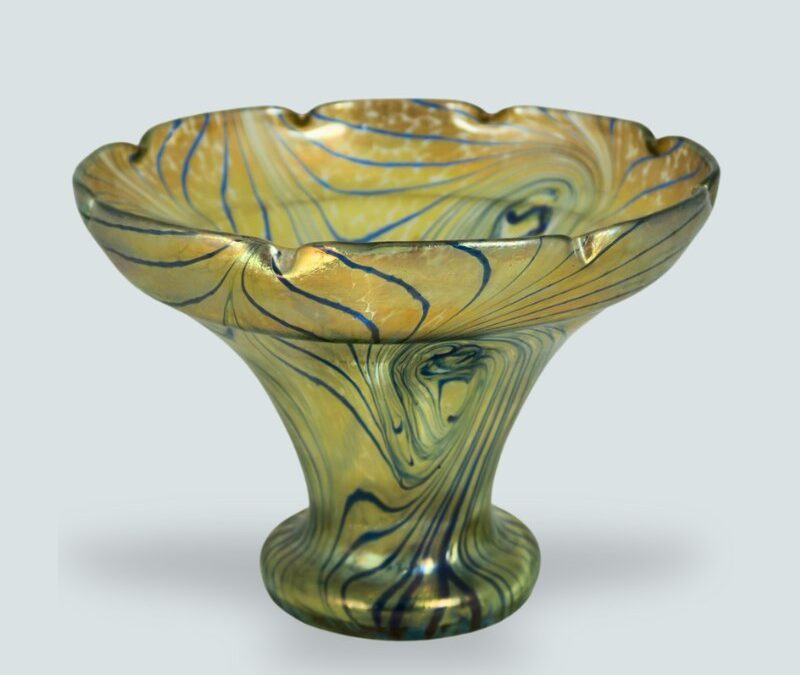
If you’ve ever picked up a piece of late 19th-century Bohemian glass and felt that little jolt of excitement, the one that says this is special, there’s a good chance you were holding something made by Fritz Heckert.
Heckert glass has that rare combination collectors chase for years: craftsmanship you can see from across the room, detail you only fully appreciate up close, and a body of work broad enough to stay interesting for a lifetime. It can be flamboyant and theatrical, as seen in pieces like the Fritz Heckert Changeant vase, but it can also be quietly refined. Either way, it tends to feel alive in the light.
This guide is written for collectors who want to understand what makes Fritz Heckert glass distinctive, how to identify it, what styles to look for, and what to watch out for when you’re buying. For those interested in acquiring such pieces, buying art glass comes with its own set of challenges and rewards.
Who was Fritz Heckert (and why does his glass matter)?
Fritz Heckert was a Bohemian glass manufacturer working in what is now the Czech Republic during the period when Bohemia was one of the great powerhouses of European decorative arts. The late 1800s were intensely competitive: factories were innovating fast, international exhibitions were a big deal, and wealthy buyers wanted novelty, colour, and virtuoso technique.
Heckert’s firm became known for high-end decorative glass that could stand shoulder to shoulder with the best work coming out of the region. When people talk about “Bohemian excellence” from this era, Heckert rightly sits in that conversation alongside other major names.
For today’s collector, that matters because:
- Heckert pieces often show multiple advanced techniques in one object.
- The aesthetic range is wide: it’s not just one look or one colourway.
- Properly identified examples have serious collector appeal and enduring value.
Whether it’s a Fritz Heckert Changeant vase or a more understated piece like the Fritz Heckert vase, each item tells a story of meticulous craftsmanship and artistic innovation.
The “Heckert look”: what to expect at first glance
Even before you start thinking about marks and attribution, Heckert glass tends to announce itself through a few recurring traits. Not every piece shows all of these, but they’re useful signals.
Rich colour and strong contrast
Bohemian makers excelled at coloured glass, and Heckert is no exception. You’ll often see deep, saturated hues with deliberate contrast, either through overlays, cased colours, or painted enamels.
Confident decoration
Heckert decoration often feels purposeful rather than fussy. There’s a sense that the maker knew exactly where to place detail so the whole object reads cleanly across a room.
Light-handling surfaces
Whether the surface is engraved, enamelled, iridescent, or cut, there’s usually an attention to how light plays across it. Turn a good piece slowly and it rewards you.
Key styles and techniques in Fritz Heckert glass
One of the easiest ways to collect Heckert is to learn the main “families” of work associated with the factory and period. You don’t need to memorise every pattern name. Focus on technique and visual language.
1) Enamelled and painted decoration
Many Heckert pieces feature enamel painting, sometimes floral, sometimes figurative, sometimes in decorative panels. Look for:
- Fine line work and controlled shading.
- Motifs that sit naturally on the form, rather than looking “stuck on”.
- Consistency: cheap later decoration can look flat or clumsy, especially around edges.
A good enamelled piece tends to have clarity and intention. Under magnification, the better work looks crisp, not muddy.
For instance, take a look at this Fritz Heckert vase which exemplifies these characteristics beautifully. Or explore more about Fritz Heckert’s style in our detailed guide.
Heckert glass also showcases a variety of styles such as the Kralik Chine vase or the exquisite Kralik centrepiece, both of which are great examples of the versatility in design that Heckert offers. Additionally, don’t miss out on our collection of Kralik vases which further highlight the unique aesthetic appeal of Heckert glass.
2) Engraved glass (often floral and ornamental)
Engraving is a huge part of Bohemian prestige glass. With Heckert, you may encounter:
- Delicate wheel engraving with botanical themes.
- More assertive ornamental engraving that creates a lace-like surface.
- Combinations of engraving with coloured grounds or overlays.
When engraving is strong, it has depth and rhythm. Weak engraving can look scratchy, shallow, or uneven in spacing.
3) Cameo-style and relief effects
Cased glass and cameo-like approaches show up across Bohemia. With Heckert-related pieces, you might see layered colours worked to reveal patterns or relief motifs. These can be very desirable, but they’re also a category where misattribution happens, so buy with your eyes open and your references close.
For instance, the Pallme König glass often showcases these techniques beautifully.
4) Iridescent and “art glass” surfaces
Depending on the specific piece and period, you may find shimmering surfaces that nod to the broader European fascination with iridescence. The best examples feel integrated into the design, not like an afterthought.
5) Form matters: vases, beakers, bowls, and showpieces
Collectors often focus on decoration, but Heckert forms can be a clue in themselves. Many pieces have elegant proportions and a balanced silhouette. The rim finish, foot, and transitions between sections are worth studying. High-quality Bohemian glass tends to feel resolved from top to bottom.
For instance, Kralik vases are known for their elegant forms and intricate designs.
Marks, signatures, and labels: helpful, but not the whole story
Collectors love a mark, and for good reason. But with Heckert glass, you’ll see a mix of situations:
- Some pieces are marked or labelled.
- Some are unmarked but attributable by style and technique.
- Some are “associated” pieces where the attribution is debated, overstated, or simply wrong.
This is common with Wilhelm Kralik’s works as seen in this Kralik vase which may sometimes lead to misattribution despite its distinctive design elements.
What to do instead of relying on one stamp
Use marks as supporting evidence, not the entire case. Build your attribution from:
- Form and construction quality.
- Decorative technique and execution.
- Consistency with documented examples.
- Provenance and old labels where available.
If you’re buying online, ask for photos of the base, pontil area, and any wear. A surprising amount of truth lives on the underside of a vase.
How to judge quality (the collector’s checklist)
When you’re holding a potential Heckert piece, slow down and check the fundamentals. This is where good buying habits save you money and regret.
1) Clarity of workmanship
- Crisp engraving rather than fuzzy lines.
- Enamel that looks deliberate and stable.
- Gilding that has aged naturally rather than looking freshly applied.
2) Balance of design
Great Bohemian decorative glass has a sense of composition. The decoration should suit the form. Watch for pieces where the design feels awkwardly scaled or oddly positioned, which can indicate later embellishment.
3) Wear that makes sense
Honest age is not the enemy. In fact, it can be reassuring. You’re looking for:
- Light base wear consistent with careful use.
- Minor gilt rubbing that matches handling points.
- No suspicious “newness” on a piece being sold as 19th century.
4) Condition (and what’s acceptable)
Condition affects value, but not every flaw is a deal-breaker if the piece is rare or outstanding.
Check for:
- Rim chips, especially tiny ones hidden under dark photography.
- Hairline cracks, often visible when held to light.
- Repairs, which may fluoresce under UV light or show as odd texture changes.
- Over-cleaning, which can soften engraved detail or dull a surface.
The most common pitfalls (and how to avoid them)
Misattribution by seller enthusiasm
Bohemian glass is a maze. Many sellers use “Heckert” as shorthand for “fancy Bohemian”. That doesn’t mean they’re dishonest; sometimes it’s simply inherited description.
Protect yourself by comparing the listing to museum examples, reputable catalogues, and established dealer descriptions.
Later decoration on earlier blanks
One of the classic traps: an older blank vase that has been enamelled or gilded later to make it more saleable. Signs include:
- Decoration that sits oddly on the form.
- Gilding that looks too bright and un-aged.
- Inconsistent style elements mashed together.
Modern reproductions and “Bohemian-style” pieces
Some modern glass borrows heavily from 19th-century aesthetics. Modern does not automatically mean bad, but modern presented as antique is a problem.
If the price seems too good for a spectacular piece, assume you’re missing something and investigate.
Building a collection: smart strategies that actually work
Collecting Heckert glass can be thrilling, but it’s easy to get distracted by shininess. A few grounded strategies make the hobby far more rewarding.
Start with one lane
Pick a focus for your first 3 to 5 pieces:
- Enamelled florals
- Engraved clear or lightly tinted glass
- Cameo-style cased pieces
- Portrait or figurative panels
- A specific form, like tall vases or beakers
Focusing helps your eye develop fast. Later, you can branch out with confidence.
Buy the best example you can afford
In Bohemian glass, quality shows. A single excellent piece often brings more long-term satisfaction than three mediocre ones.
For instance, a Fritz Heckert vase or a Wilhelm Kralik vase could serve as ideal examples of high-quality pieces worth investing in.
Photograph and document everything
Keep a simple record:
- Measurements, weight if relevant.
- Clear photos of base, rim, and decoration close-ups.
- Where you bought it, date, price, and any seller notes.
This is incredibly useful for insurance, resale, and learning.
Learn from handling real glass
If you can, visit fairs, antiques centres, and museums. Photographs flatten glass. In person, you can see depth, sparkle, and surface nuance that makes attribution and quality assessment much easier.
Display and care: keeping Heckert glass beautiful
Heckert pieces are decorative, yes, but they’re also historical objects.
- Light: Avoid prolonged direct sunlight, particularly for pieces with painted enamels or sensitive surface effects.
- Cleaning: Skip harsh chemicals. Use a soft cloth and gentle methods. For anything gilded or enamelled, be cautious with rubbing.
- Handling: Lift from the body and support the base. Avoid gripping by the rim.
- Storage: If storing, wrap carefully and keep pieces stable. Chips happen most often during moving and re-arranging.
What is Fritz Heckert glass worth?
Value depends on several variables, and the range can be wide. The biggest drivers tend to be:
- Confirmed attribution and quality of documentation.
- Rarity of the form or decoration.
- Condition, especially rim integrity and absence of repairs.
- Visual impact and craftsmanship.
If you’re trying to estimate a specific piece like a Fritz Heckert or Wilhelm Kralik vase, the most reliable method is to search sold results from reputable auction houses and compare like with like: similar size, similar technique, similar complexity, similar condition.
A quick buying checklist (save this for your next hunt)
Before you buy, ask yourself:
- Does the quality of engraving/enamel/gilding look genuinely high-level?
- Does the decoration feel integrated with the shape?
- Do the wear patterns look natural for the age claimed?
- Have you seen close-up base and rim photos?
- Can you find at least one credible reference example that feels genuinely comparable?
- If the piece is expensive, is the attribution supported by more than a vague description?
If you can tick most of those boxes, you’re probably making a sensible purchase.
Final thoughts: why Heckert is worth collecting
Fritz Heckert glass sits in that sweet spot where artistry, technical ambition, and decorative joy all meet. It’s the kind of glass that can stop you mid-step at a fair, the kind that makes you change your route through an antiques centre because you spotted a particular glow on a shelf.
Collect it patiently. Learn the techniques. Trust your eye as it sharpens. And when you find a piece that feels unmistakably right, don’t be surprised if you end up building a whole cabinet around it.
FAQs (Frequently Asked Questions)
Who was Fritz Heckert and why is his glass significant?
Fritz Heckert was a Bohemian glass manufacturer from the late 19th century, working in what is now the Czech Republic. His glass is significant because it represents Bohemian excellence in decorative arts, showcasing advanced techniques, a wide aesthetic range, and enduring collector appeal.
What distinctive features help identify Fritz Heckert glass at first glance?
Heckert glass often features rich, saturated colours with strong contrasts, confident and purposeful decoration, and surfaces designed to play beautifully with light through engraving, enamelling, iridescence, or cutting.
What are the main styles and techniques used in Fritz Heckert glasswork?
Key styles include enamelled and painted decoration characterised by fine line work and natural motifs; delicate or ornamental engraved glass often with floral themes; and cameo-style or relief effects using cased glass overlays to create depth.
How can I distinguish authentic enamelled decoration on Fritz Heckert pieces?
Authentic enamelled decoration features fine line work with controlled shading that sits naturally on the glass form. Under magnification, quality enamelling appears crisp and intentional rather than flat or clumsy, especially around edges.
Why do collectors value Fritz Heckert glass highly today?
Collectors value Heckert glass for its combination of meticulous craftsmanship, artistic innovation, multiple advanced techniques in single pieces, a broad stylistic range, and its status as a hallmark of Bohemian decorative art excellence.
What should buyers watch out for when purchasing Fritz Heckert art glass?
Buyers should look for proper identification to ensure authenticity, examine the quality of decoration and engraving for clarity and depth, be aware of inconsistent or poor-quality later additions, and understand the historical context to appreciate the piece’s value fully.