
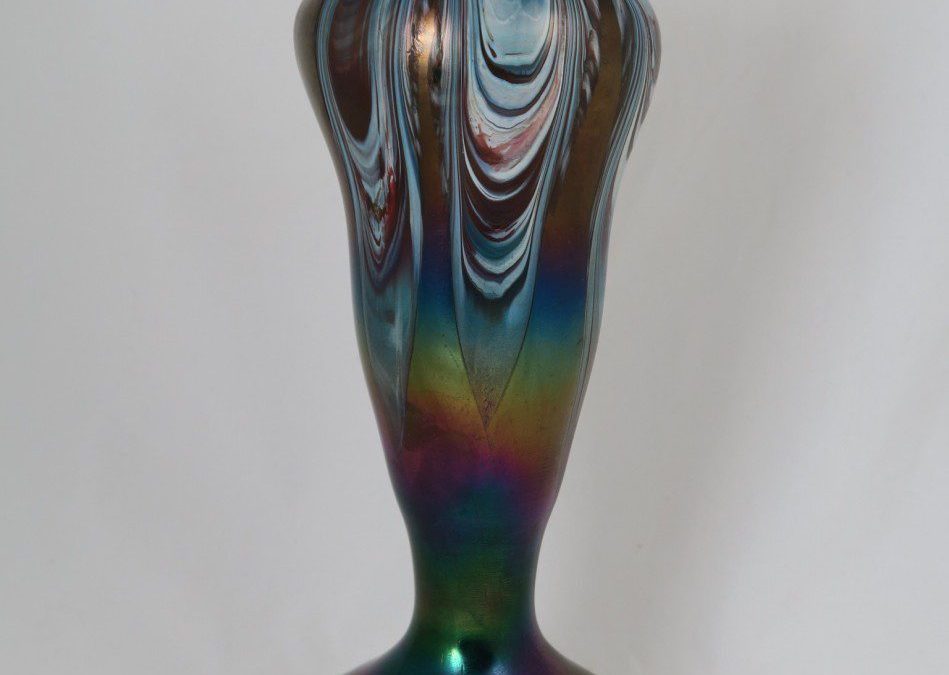
Iridescent glass has one of those magical qualities that photographs never quite capture. You can hold a vase still, swear it’s a soft sea-green, then tilt it half a degree and watch it flare with violet, gold, and electric blue. It feels alive, almost like it’s borrowing colour from the air around it.
That sense of movement, shimmer, and transformation is exactly why iridescent glass became one of the defining materials of the Art Nouveau era. Art Nouveau didn’t just want decoration. It wanted enchantment. It wanted nature, light, sensuality, and modernity all in the same object, whether that object was a lamp, a perfume bottle, or a monumental window panel.
Let’s unpack what iridescent glass actually is, how it’s made, and why it was such a perfect match for the Art Nouveau imagination.
What is iridescent glass?
Iridescent glass is glass that displays shifting, rainbow-like colours depending on the angle of light and the viewer’s position. The effect is similar to what you see on a soap bubble, a peacock feather, a beetle’s wing, or the inside of a seashell.
Two important points make iridescent glass different from “just colourful glass”:
- The colour is optical, not simply pigment-based. Some of what you’re seeing is caused by thin layers interacting with light, not only dyes within the glass.
- The appearance changes constantly. You do not get one stable colour. You get a spectrum that slides and blooms as the surface catches light.
You’ll sometimes hear people use terms like lustre, opalescent, mother-of-pearl, or oil-slick when talking about similar effects. They overlap in feel, but they are not all the same thing. Iridescence is specifically about that angle-dependent colour shift.
This unique quality can be seen in various antique pieces such as the stunning Josef Rindskopf vase, or the exquisite Wilhelm Kralik Martele vase and tri-footed amphora vase. The enchanting Loetz Arcadia bowl also serves as a prime example of this mesmerizing material’s potential. Even more striking are pieces like the Rindskopf snake vase which embody the essence of iridescent glass in their design.
How is iridescent glass made?
There are a few routes to achieving iridescence in glass, but during the Art Nouveau period, the most renowned iridescent effects typically resulted from surface treatments or vapour-based processes that created an extremely thin metallic or mineral layer.
Here are the main methods you’ll encounter:
1) Metallic salt vapour treatments (the classic “lustre” look)
In many historic processes, the glass is exposed to fumes or solutions containing metallic salts. Under heat, these form a microscopic layer on the surface. Because the layer is so thin, it interferes with light waves, producing the shifting rainbow effect. This sort of process is associated with iconic Art Nouveau iridescent wares such as Rindskopf marbled vases and Pallme-König vases.
2) Reduced oxygen environments (creating metallic sheen)
Some finishes are achieved by reheating glass in conditions with reduced oxygen. This can encourage certain compounds to form a reflective, metallic surface. The look can range from soft pearl to intense mirror-like sheen depending on the formulation.
3) Weathering (true ancient iridescence)
A fascinating aspect of iridescence is that it can also appear naturally when buried glass ages over centuries. Chemical reactions in soil create thin layered corrosion, and those layers produce iridescence. Art Nouveau makers were not relying on burial for this effect, but the visual similarity adds to its allure – it resembles something unearthed from a forgotten palace.
4) Internal effects: opalescence and layered glass
Not all “glowy” Art Nouveau glass is surface-iridescent. Some makers used opalescent glass (milky, light-diffusing) or layered glass (cased glass) with carving and etching. These techniques don’t always create iridescence in the strict optical sense, but they often work alongside it to intensify depth and atmosphere.
The key idea is that Art Nouveau glassmakers became obsessed with light as a material. Iridescence is essentially light engineered into the surface. This obsession with light can be seen in various forms of Art Nouveau glass such as Wilhelm Kralik’s sea urchin vases, Loetz Neptun vases and Kralik martele teardrop vases.
Why did iridescent glass fit Art Nouveau so perfectly?
Art Nouveau flourished roughly from the 1890s to the early 1910s, depending on the country and the movement’s local name. It was a reaction against stale historic revival styles and an embrace of modern life, but it wasn’t coldly industrial. It was modernity filtered through nature, sensuality, and craftsmanship.
Iridescent glass matched Art Nouveau’s core values in several powerful ways.
1) It mimicked nature better than almost any other decorative material
Art Nouveau artists were obsessed with living forms: iris petals, dragonfly wings, lilies, vines, waves, smoke, hair. Nature is not flat colour. Nature shimmers. It changes as you move.
Iridescence offered a shortcut to that truth. The glass could echo:
- Insect wings with their shifting membranes
- Pearls and shells with their inner glow
- Dew on leaves catching early light
- Fish scales flashing under water
- Feathers and their oily, spectral highlights
When you see an Art Nouveau vase with a sinuous profile and an iridescent skin, it doesn’t feel “painted”. It feels grown. Consider the exquisite Rindskopf marbled vase or the enchanting Loetz Neptun vase/jug, both perfect examples of this organic aesthetic.
2) It turned everyday objects into theatre
One of the great joys of Art Nouveau is how it treated domestic life as worthy of beauty. A simple lamp could be as poetic as a sculpture. A decanter could feel like an exotic flower.
Iridescent glass helped accomplish that without adding clutter. The form could remain elegant and restrained, yet the surface would do the dramatic work. In candlelight or gaslight, and later in electric light, the shimmer becomes performance.
This transformative quality can be seen in pieces like the Kralik crackle vase or the Kralik Martele enamelled vase, where the iridescence elevates them from mere objects to theatrical statements.
And that matters because Art Nouveau emerged during a period when lighting itself was changing. Interiors were transforming. People were experiencing new kinds of glow, reflection, and illumination. Iridescent glass didn’t just sit in those spaces. It answered them.
The interplay of light and form in iridescent glass also has practical applications, as seen in functional pieces like the Pallme König shade smoke baffle, demonstrating how these artistic principles extended beyond aesthetics into everyday utility.
3) It bridged craft tradition and modern chemistry
Art Nouveau loved the hand of the maker, but it also loved experimentation. Glassmaking was a perfect arena because it sat right between art and science.
Iridescent finishes, in particular, relied on knowledge of heat, timing, atmosphere, and chemical reactions. This gave Art Nouveau an exciting modern edge. The results felt almost alchemical: base materials transformed into something luminous and strange.
That blend of artisanal skill and scientific curiosity is part of why Art Nouveau glass still feels so contemporary. It is not merely nostalgic. It is inventive.
4) It suited Art Nouveau’s love of fluid, ambiguous surfaces
Art Nouveau often avoided harsh boundaries. It preferred gradients, dissolving edges, and transitions between states: flower into woman, vine into hair, mist into fabric.
Iridescent glass embodies that philosophy on a micro level. The colour does not hold still. It glides across the surface. It refuses to be pinned down.
In other words, iridescence is the visual equivalent of Art Nouveau linework. Both are continuous, flowing, and alive.
The big names: who made Art Nouveau iridescent glass famous?
You can find iridescent glass across Europe and America, but a few names come up again and again because they pushed the effect into the spotlight.
Louis Comfort Tiffany (United States)
Tiffany’s studio popularised an iridescent glass known as Favrile. It became synonymous with Art Nouveau luxury in America, appearing in vases, bowls, and the celebrated lamps with richly coloured shades.
Tiffany’s approach was not just about surface sparkle. It was about depth, layered colour, and a kind of saturated, jewel-like radiance. Many pieces feel like they contain their own sunset.
Josef Rindskopf (Europe)
In Europe, Josef Rindskopf, a Czech glassmaker, made significant contributions to the field of iridescent glass during the Art Nouveau period. His vases are particularly notable for their unique designs and striking iridescent finishes that perfectly encapsulate the spirit of this artistic movement.
Émile Gallé (France)
Gallé’s glass often leans toward poetry and botany, frequently incorporating plant motifs, cameo carving, and layered effects. While not every Gallé piece is iridescent, the broader Art Nouveau glass world he helped define was deeply invested in luminous, nature-based surfaces.
Gallé is a reminder that Art Nouveau iridescence sits within a bigger family of glass experiments: acid-etching, wheel carving, marquetry-like inclusions, and multi-layered colour.
The Loetz factory (Bohemia, now Czechia)
Loetz is legendary among collectors for its intensely beautiful Art Nouveau glass, including iridescent finishes that can look like rippling oil on water or mother-of-pearl satin. Their work often captures what people mean when they say “Art Nouveau glass” in one breath: organic forms, bold colour, and a surface that seems to move. For more information on Loetz glass, you can visit the provided link.
René Lalique (France)
Lalique is often associated with jewellery and later with glass in a slightly different register, including frosted and moulded glass. But he is part of the same Art Nouveau ecosystem that prized light effects and sensuous surfaces, especially in objects designed to be held, worn, or admired up close.
He helps explain why the era cared so much about tactile beauty. Iridescent glass is not only visual. It invites touch.
Iridescent glass in architecture and interiors
When people picture Art Nouveau, they often think of posters, jewellery, or curving doorways, but glass was everywhere:
- Windows and transoms that turned daylight into coloured atmosphere
- Lamps and sconces that made electric light feel warm and organic
- Tiles and decorative panels that reflected interiors into new tones
- Vessels and tableware that made dining feel ceremonial
Iridescent surfaces played especially well in these contexts because Art Nouveau interiors were frequently designed as unified worlds. The shimmer of a vase could echo the glow of a lamp and the gleam of metalwork nearby. The room became a composition of light.
For those interested in buying Art glass, this guide may provide valuable insights into the process. Additionally, if you’re curious about specific types of glass such as Kralik glass or Pallme-Konig glass, there are resources available to help you learn more about these unique styles.
Why did iridescent glass fade after Art Nouveau?
Trends shifted quickly in the early 20th century. After the lush curves of Art Nouveau came movements that favoured different ideals:
- Art Deco leaned into geometry, symmetry, and glamour with sharper edges.
- Modernism often rejected ornament entirely, preferring clarity, function, and industrial honesty.
Iridescent glass, with its romantic, nature-like shimmer, could feel too expressive for the new mood. It never disappeared, but it stopped being the flagship aesthetic of modern design.
Interestingly, the very thing that made it feel dated to some people later became the reason it stayed desirable. Iridescent Art Nouveau glass doesn’t look like everything else. It has a voice.
How to recognise genuine Art Nouveau iridescent glass (quick practical cues)
If you’re looking at a piece and wondering whether it belongs to the Art Nouveau world, here are a few clues that often show up together:
- Organic silhouettes: swelling bodies, trumpet mouths, asymmetry, whiplash curves.
- Nature motifs: flowers, seedpods, dragonflies, water plants, vines.
- Integrated decoration: pattern and form designed as one, not decoration “stuck on”.
- Light-first surfaces: iridescence, opalescence, satin finishes, layered depth.
- A sense of movement even when the object is still.
Marks, signatures, and provenance matter a lot in authentication, but aesthetically Art Nouveau iridescent glass tends to announce itself. It feels like an object mid-transformation.
So, why did it define the era?
Because Art Nouveau was, at heart, a movement about making the modern world feel enchanted again. It believed that beauty belonged in daily life, that nature could guide design, and that materials could be pushed into new emotional territory.
Iridescent glass did all of that in one stroke. It captured nature’s shimmer, celebrated the era’s love of light, and showcased a thrilling mix of artistry and technique. Most importantly, it made people stop and stare.
And if you’ve ever seen a true Art Nouveau iridescent vase in person, you know that it still works. The colour shifts, the surface glows, and for a moment the object feels less like an object and more like a living thing made out of light. That is exactly the Art Nouveau dream.
FAQs (Frequently Asked Questions)
What is iridescent glass and how does it differ from regular coloured glass?
Iridescent glass is a type of glass that displays shifting, rainbow-like colours depending on the angle of light and the viewer’s position. Unlike regular coloured glass, its colour is optical rather than pigment-based, caused by thin layers interacting with light. This results in a constantly changing spectrum of colours, giving it a shimmering, alive quality.
Why was iridescent glass so significant during the Art Nouveau era?
Iridescent glass perfectly embodied the Art Nouveau movement’s desire for enchantment, nature, light, sensuality, and modernity all in one object. Its sense of movement, shimmer, and transformation aligned with Art Nouveau’s aim to create objects that were not just decorative but also magical and alive with colour and light.
How is iridescent glass traditionally made to achieve its unique colour effects?
During the Art Nouveau period, iridescent effects were mainly achieved through surface treatments such as metallic salt vapour treatments that form microscopic layers on the glass surface. Other methods include reheating glass in reduced oxygen environments to create metallic sheens and layering techniques like opalescence or cased glass carving. These processes manipulate light interaction to produce shifting rainbow hues.
What are some common terms related to iridescence in glass, and how do they differ?
Terms like lustre, opalescent, mother-of-pearl, and oil-slick are often used when discussing similar effects in glass. However, iridescence specifically refers to angle-dependent colour shifts caused by optical interference. While these terms overlap in feel, not all denote true iridescence; for example, opalescence relates more to milky translucence than shifting colours.
Can iridescence occur naturally in glass without human intervention?
Yes, true ancient iridescence can appear naturally when buried glass ages over centuries. Chemical reactions in soil create thin layered corrosion on the surface which produces an iridescent effect resembling those crafted intentionally during the Art Nouveau era. This natural phenomenon adds to the allure of iridescent glass as it evokes something unearthed from a forgotten palace.
Which notable artists or pieces exemplify the beauty of iridescent glass from the Art Nouveau period?
Notable examples include Josef Rindskopf vases known for their soft sea-green flares into violet and gold hues; Wilhelm Kralik’s Martele and tri-footed amphora vases; Loetz Arcadia bowls with mesmerising colour shifts; and Rindskopf snake vases which embody iridescence’s essence. These pieces showcase the magical qualities and technical mastery of Art Nouveau iridescent glassmakers.