
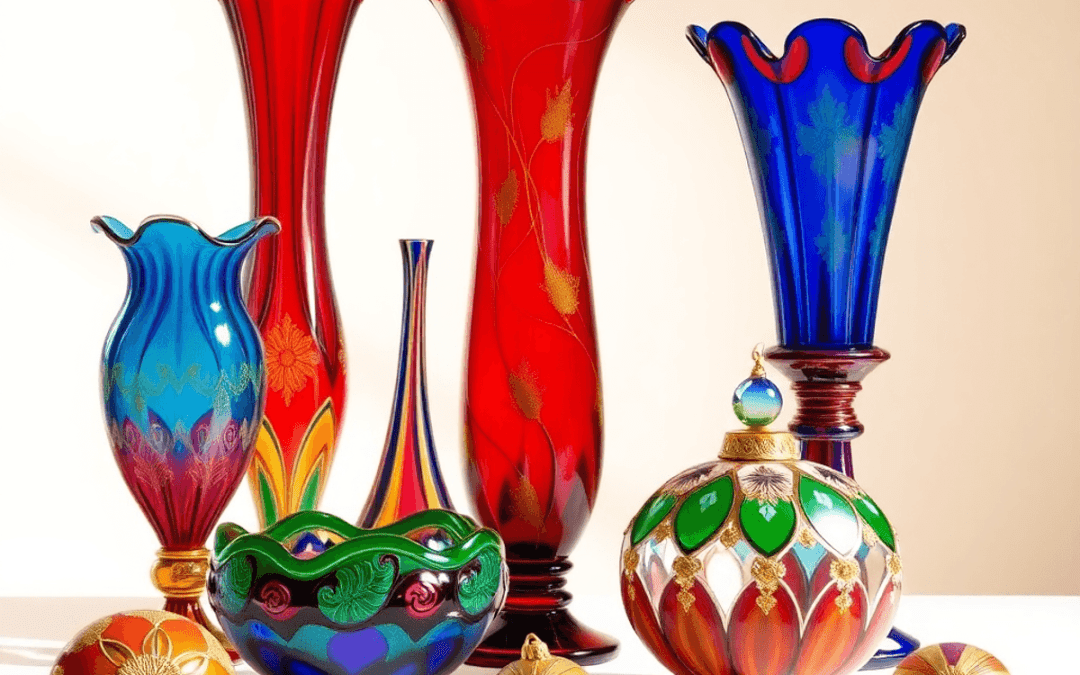
Bohemian art glass has a way of stopping you in your tracks. Sometimes it’s the colour, a deep ruby or a smoky amethyst. Sometimes it’s the surface, all crackle and glitter, like frost on a winter window. And sometimes it’s simply the feel of it: surprisingly weighty, confidently made, with that unmistakable sense that the maker knew exactly what they were doing.
“Bohemian glass” can mean a lot of things depending on who’s saying it. In the broadest sense, it refers to glass made in Bohemia, a historic region that now sits largely within the Czech Republic. More specifically, collectors often use it to describe decorative and studio glass from the late 19th century onwards, including Art Nouveau, Art Deco, mid-century modern and contemporary work.
This guide is here to make that big, beautiful world easier to navigate: the key makers, the most recognisable styles such as the exquisite Bohemian vases or the striking cobalt vases, and what to look for when you’re trying to identify a piece.
Why Bohemia became a glassmaking powerhouse
Bohemia had three things that glassmakers loved: forests for fuel, clean silica and potash for glassmaking, and a long tradition of skilled craftsmanship. By the 17th and 18th centuries, Bohemian glass was competing with Venetian glass and admired across Europe. The region became especially famous for high-quality crystal, intricate cutting and later for bold decorative techniques that suited changing tastes.
By the time you reach the late 1800s and early 1900s, Bohemian factories were producing some of the most inventive decorative glass in the world. This includes notable styles such as those from Pallme König known for their unique vases or Rindskopf which are highly sought after by collectors today. The international reach of these products is a big reason why you still find them today in antique shops, fairs, and family cabinets far from Central Europe.
The key styles of Bohemian art glass (and how to recognise them)
1) Cut crystal and engraved glass
If you picture “classic Bohemian”, you may be thinking of clear crystal with sharp, geometric cutting, sometimes with engraved decoration layered on top. It can be formal, dazzling and very precise.
What to look for
- Crisp cuts that catch the light sharply
- Star bases, panels, and repeated motifs
- Fine wheel engraving: floral sprays, crests, scenes, or monograms
Common forms Decanters, bowls, goblets, lidded jars, perfume bottles, presentation pieces.
Cut crystal is a huge category and spans centuries, so dating depends on shape, quality, and any marks.
2) Overlay glass (cased and cut)
Overlay glass is one of the most collectible Bohemian traditions. A layer of coloured glass is “cased” over clear crystal, then cut back to reveal patterns, panels, or decorative scenes. Ruby over clear is the classic look, but blue, green and amber overlays appear too.
What to look for
- A clear “step” where the coloured layer has been cut away
- Cut designs that reveal the clear glass beneath
- Strong colour depth at thicker points
Why it matters Overlay pieces often signal skilled production, and the cutting can be a clue to workshop quality.
3) Enamelled and gilt glass
Enamelled decoration, sometimes paired with gilding, shows up in both earlier and later Bohemian work. Think floral sprays, raised enamel dots, scrolling borders and lavish gold bands.
What to look for
- Slightly raised enamel paint you can feel with a fingernail
- Gilding that may wear on high points (normal for older pieces)
- Decorative borders around rims and feet
This style can be especially tricky to date because factories revived older looks again and again for export.
4) Tango glass and other Art Deco colour ways
In the 1920s and 1930s, bright, punchy colours arrived. “Tango” glass usually means strong contrasting colours, often an orange body with black or green details, or vice versa. It’s bold, graphic and very Deco.
What to look for
- High-contrast combinations
- Clean, modern shapes
- Coloured rims, feet, handles, or applied accents
Tango is commonly associated with Bohemian production, and it remains a favourite entry point for new collectors because it’s fun, unmistakable and often affordable.
5) Spatter, splatter and “granulated” surfaces
This is where Bohemian glass gets especially playful. Some pieces have a speckled or spattered look, others appear “sugared” with granules fused into the surface. You’ll also see confetti-like effects and bold texturing.
What to look for
- Even distribution of colour flecks or granules
- Textured surfaces that sparkle under light
- Often paired with simple forms so the surface does the talking
This category overlaps with a maker that comes up again and again: Kralik.
6) Iridescent and Art Nouveau forms
Art Nouveau Bohemian glass often leans into organic shapes: swelling bodies, sinuous handles, floral mounts, and luminous surfaces. Iridescence, can look petrol-like or pearl-like, shifting in the light.
What to look for
- Soft, flowing outlines and asymmetry
- Iridescent sheen, sometimes subtle, sometimes dramatic
- Applied trails, prunts, or decorative handles
This is also where attribution gets complicated because several factories made similar fashionable wares.
7) Sommerso, controlled bubbles and studio-era experiments
Post-war Czech glass is a world of its own. From the 1950s onwards, designers and glassworks produced pieces that feel sculptural and modern: heavy blocks, optical effects, submerged colours (sommerso-like layering), controlled bubbles, and sharply polished facets.
What to look for
- Thick, heavy forms with clean polishing
- Bubbles placed intentionally, not randomly
- Colour that appears suspended within clear glass
This area includes the famous names that collectors chase hard today.
Key Bohemian and Czech makers you’ll see often
A quick note before we dive in: many pieces are unmarked, and labels often fall off over time. So “maker” sometimes means “most commonly attributed to”, based on documented patterns, known labels, and specialist references. That’s part of the challenge and part of the joy.
Moser (Karlovy Vary)
Moser is the luxury benchmark. Known for exceptionally high-quality crystal, refined engraving, and a level of finish that feels effortlessly expensive.
Typical Moser traits
- Superb clarity and precision
- Elegant, often classical shapes
- High-end engraving, sometimes with impeccable gilding
- Many pieces are acid-marked “Moser” or have surviving labels, but not always
If you pick up a piece and the cutting and polishing look almost too perfect, Moser is always worth considering.
Loetz (Klostermühle)
Loetz is one of the most important names in Art Nouveau glass. Their iridescent surfaces and sculptural forms were genuinely innovative, making them a key player in the market. You can find more detailed information about Loetz glass here.
Typical Loetz traits
- Iridescent finishes, sometimes with a fine, oily sheen
- Art Nouveau silhouettes: organic, balanced, alive
- Certain décor names are documented, and pattern identification can be very specific
Loetz is widely collected, and prices reflect that. It’s also frequently imitated or misattributed, so do your homework if you’re buying at the higher end.
Kralik (Wilhelm Kralik Sohn)
Kralik is beloved for texture, colour, and sheer variety. You’ll see spatter effects, pulled feathering, crackle, iridescence, and bold decorative surfaces.
Typical Kralik traits
- Distinctive surface treatments, often highly recognisable once you’ve seen a few
- Strong colour palettes
- Forms that range from traditional vases to more modern shapes
Kralik is a name you’ll encounter constantly in the Bohemian art glass world, especially in the “decorative and affordable” sweet spot. For instance, pieces like the Wilhelm Kralik Martele vase or the Kralik coral vases exemplify the unique charm and craftsmanship associated with this brand.
Ruckl
Ruckl is one of the key Czech glassmaking families, particularly known for fine crystal and cutting. For collectors who love precision and sparkle, it’s a rewarding direction to explore.
Typical Ruckl traits
- High-quality crystal
- Clean, confident cutting
- Both traditional and modern designs depending on period
Marks vary, and some pieces are stickered rather than signed.
Harrach (Nový Svět)
Harrach has a long history and produced a wide range of decorative glass, including engraved and high-quality crystal wares. They’re important in the story of Bohemian glass and show up in collections that skew earlier and more formal.
Typical Harrach traits
- Traditional forms, often finely finished
- Engraving and refined decoration
- Historical depth: pieces can span different eras and revival styles
Egermann
Egermann is strongly associated with decorated glass, including ruby staining and etched designs that create sharp contrast. You’ll often see souvenir-style pieces too, but also genuinely beautiful decorative work.
Typical Egermann traits
- Ruby-stained glass with etched patterns
- Decorative scenes, floral motifs, and repeating designs
- Often sold widely, so it appears frequently on the secondary market
Železný Brod (ZBS) and the Czech studio tradition
Železný Brod Sklo and related Czech studio production introduced a more modern design language, often with thick glass, controlled bubbles, strong form, and sculptural presence. This is where Czech glass starts to feel like contemporary art rather than ornament.
Typical traits
- Heavier, architectural forms
- Bold colour blocked within clear glass
- Polished bases, clean finishing
Skrdlovice
Skrdlovice is one of the most collected post-war Czech glassworks, with designs that feel both modern and lyrical. Pieces can range from restrained to flamboyant, but quality is generally strong.
Typical traits
- Sculptural vases and bowls, often with vivid colour
- Mid-century modern forms
- Frequently stickered when original labels survive
Designers to know: Libenský and Brychtová
If you fall for thick cast glass with optical depth and a kind of quiet monumentality, you’re probably heading towards Stanislav Libenský and Jaroslava Brychtová. Their work is rightly revered.
Typical traits
- Cast glass, often with geometric or architectural forms
- Subtle colour, strong internal light effects
- Pieces may be signed, but provenance matters a lot in this category
This is a more specialist market, but it’s one of the most exciting areas of Czech glass to explore.
How to identify Bohemian art glass in the wild
Start with the feel and finish
Bohemian and Czech glass often has a particular confidence to it. Bases tend to be well-polished. Rims are finished cleanly. Decorative techniques are crisp rather than sloppy.
If a piece looks flashy but feels thin, rough, or poorly finished, it may be a later mass-market imitation.
Notable Glass Types to Recognise
While exploring the world of Czech glass, it’s important to recognise some notable styles that have made their mark:
- Pallme König Glass: Known for its unique characteristics and historical significance in the realm of Czech glassmaking. More information about Pallme König glass.
- Kralik Glass: This style is renowned for its distinctive rough crackle texture as seen in pieces like the Kralik Rough Crackle Pitcher, or its martele teardrop vases such as the Kralik Martele Teardrop Vase.
- Rindskopf Glass: Another significant style that offers a range of unique designs including marbled vases and beautifully crafted vases like the Rindskopf Vase.
Look for marks, but don’t rely on them
You might find:
- Acid-etched marks (common with higher-end crystal)
- Engraved signatures (more common with studio pieces)
- Paper labels or foil stickers (often missing)
Unmarked does not mean unimportant. Marked does not automatically mean authentic. Labels are easily swapped, and plenty of genuine glass has no mark at all.
Pay attention to construction details
- Pontil marks: some studio and older pieces show pontil scars, though many factory pieces have polished bases.
- Seams: mould seams can indicate pressed or mould-blown production. That isn’t bad, but it helps with dating and category.
- Applied elements: handles, trails and feet can indicate specific traditions and periods.
Use shape as a dating clue
- Flowing, botanical lines often suggest Art Nouveau influence
- Strong geometry and contrasting colours point towards Art Deco
- Heavy sculptural forms with polished flats often suggest post-war Czech design
Be cautious with the word “Bohemian”
Sellers sometimes use “Bohemian” loosely for anything decorative, colourful, or vaguely European. If you want real Bohemian or Czech production, train your eye on techniques and finishing, not just the listing title.
Collecting tips: buying what you love, and buying well
- Pick a lane at first. Overlay crystal, Tango, iridescent Art Nouveau, post-war sculptural glass. You’ll learn faster if you focus.
- Handle as much glass as you can. Fairs, auctions, museums, even charity shops. Your hands will teach you what photos can’t.
- Photograph bases and profiles. When researching, the base finish, pontil area, and silhouette are often more informative than the front view.
- Assume misattributions are common. Especially with names like Loetz and Kralik. If the price is high, demand evidence.
- Condition matters, but context matters too. Minor gilt wear can be normal. Chips on rims and feet are more serious. Polishing and restoration can affect value.
For more in-depth advice on buying art glass, consider exploring specialised resources that offer comprehensive tips and insights into the world of art glass collecting.
A simple way to think about Bohemian art glass
If you’re feeling overwhelmed, here’s a collector-friendly shortcut:
- For sparkle and tradition: cut crystal, engraved glass, Moser and Ruckl-style quality.
- For bold vintage colour: Tango and Art Deco Bohemian wares.
- For texture and visual drama: Kralik-style spatter, crackle, and iridescent finishes. Notably, Kralik glass is renowned for its unique textures and visual appeal. For instance, the Wilhelm Kralik crackle vase showcases the stunning crackle finish that Kralik is famous for, while the tri-footed amphora vase illustrates the sculptural weight characteristic of this style. The Kralik bacillus bowl and the sea urchin vase are other excellent examples of Kralik’s mastery in creating pieces with both utility and a magical aesthetic.
- For modern design and sculptural weight: Skrdlovice, ZBS, and Czech studio glass, with Libenský and Brychtová at the pinnacle.
Bohemian art glass rewards curiosity. The more you look, the more you start to recognise patterns, not just in decoration, but in ambition. It’s glass made by people who cared about the way light moves through colour, the way a surface catches the eye, and the way an object can feel both useful and magical.
Once you get that, you’re not just identifying makers and styles. You’re learning a language. And it’s a beautiful one to speak.
FAQs (Frequently Asked Questions)
What defines Bohemian art glass and why is it so captivating?
Bohemian art glass is renowned for its stunning colours like deep ruby or smoky amethyst, intricate surfaces such as crackle and glitter effects, and a substantial, confident feel that reflects skilled craftsmanship. It often features decorative styles from the late 19th century onwards, including Art Nouveau and Art Deco, making it highly prized by collectors.
Why did Bohemia become a centre for exceptional glassmaking?
Bohemia became a glassmaking powerhouse due to its abundant forests providing fuel, access to clean silica and potash essential for glass production, and a long tradition of skilled artisanship. By the 17th and 18th centuries, Bohemian glass rivalled Venetian glass in quality and style, eventually producing some of the most inventive decorative glass pieces by the late 1800s.
What are the key styles of Bohemian art glass to recognise?
Key styles include cut crystal and engraved glass featuring sharp geometric cuts; overlay (cased and cut) glass with coloured layers cut back to reveal clear patterns; enamelled and gilt glass with raised paint and gold bands; Tango glass known for bold Art Deco colour contrasts; spatter or granulated surfaces with textured colour flecks; and iridescent Art Nouveau forms showcasing organic shapes and luminous finishes.
How can I identify overlay (cased and cut) Bohemian glass?
Overlay glass is identified by a distinct ‘step’ where a coloured layer has been carefully cut away to reveal clear crystal beneath. Classic colours include ruby over clear, but blue, green, and amber overlays also exist. The depth of colour at thicker points and intricate cut designs are hallmarks of this skilled production technique.
What makes Tango glass distinctive within Bohemian art glass?
Tango glass emerged in the 1920s-30s as part of the Art Deco movement, characterised by strong contrasting colours such as bright orange paired with black or green details. It features clean modern shapes with coloured rims, feet or applied accents. Its bold graphic style makes it an accessible favourite among new collectors.
How do enamelled and gilt decorations appear on Bohemian glass pieces?
Enamelled decoration on Bohemian glass typically includes floral sprays, raised enamel dots that you can feel with a fingernail, scrolling borders, and lavish gold bands. Gilding may show wear on high points due to age. These decorative elements were used across different periods, sometimes revived repeatedly for export markets.