
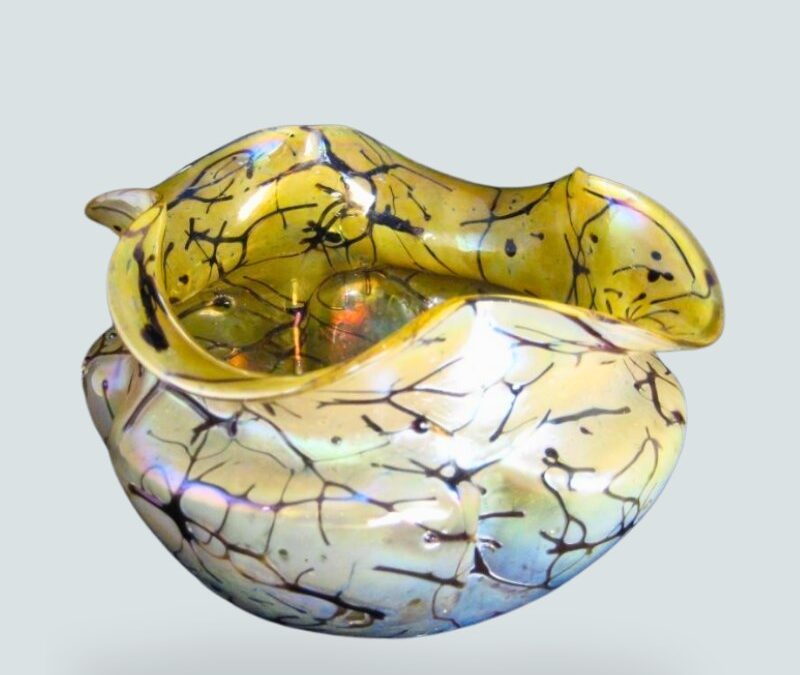
Kralik glass has that “wait… what is this?” quality that pulls you in. You’ll spot it on a shelf from across the room: shimmering iridescence, lava-like marbling, bold Art Nouveau shapes, and decoration that looks almost too modern for something made over a century ago.
But identification can get tricky fast. Many Bohemian makers worked in similar styles, patterns were copied, and a lot of genuine Kralik is unmarked. The good news is that Kralik pieces do have a set of clues that show up again and again, especially in patterns, colour palettes, and the way the glass is constructed.
This guide walks you through what to look for, how to separate Kralik from “Kralik-style”, and what the hallmarks (when they exist) can actually tell you.
A quick background: what “Kralik” refers to
Most collectors use “Kralik” to refer to glass produced by Wilhelm Kralik Sohne, a major Bohemian glassworks active in what is now the Czech Republic. Their strongest collecting categories sit in the late 19th and early 20th centuries when Art Nouveau design and iridescent finishes were at their peak.
Kralik made a wide range of items including art glass vases (like the rare crackle vase), bowls (such as the unique bacillus bowl), small decorative items, and lamp shades, often using:
- Iridescent surface treatments
- Decorative threading and trailing
- Mottled/“spatter” and marbled colourways
- Applied prunts and pulled decoration
- High-quality moulded forms
Because Bohemian glassmaking was a hotbed of innovation, you’ll also encounter overlaps with other makers such as Loetz, Rindskopf, Pallme-König, Welz, Harrach, and plenty of unnamed workshops. Identification is often about building a case using multiple features rather than relying on one “silver bullet”.
However, there are some distinctive features that can help identify genuine Kralik pieces. For instance, the Kralik coral vases are known for their unique texture and colour while the rare Wilhelm Kralik oil burner showcases the intricate designs characteristic of Kralik glass.
Step-by-step: how to identify Kralik glass reliably
When I’m assessing a piece, I work in this order:
- Form and construction
- Surface finish (especially iridescence)
- Pattern family (threading, spots, marbling, pulled work)
- Colour palette
- Base and pontil clues
- Marks and labels
- Compare against documented examples
Let’s go through the most useful identifiers.
1) Patterns strongly associated with Kralik
Iridescent “oil spot” and spatter effects
Kralik is well known for mottled, speckled, and spattered decoration under a lustrous finish. The spots can look like:
- metallic confetti
- little islands of colour in a contrasting ground
- dense peppering or larger “blobs” distributed irregularly
What to look for:
- Spots that appear embedded within the glass rather than sitting like paint on top.
- Iridescence that follows the contour of the piece evenly, not patchy in a “spray-on” way.
- A deliberate, art-glass feel to the distribution (even when the design is chaotic, it usually looks intentional).
Common confusion: Some later decorative glass imitates this look with surface coatings that appear dull, flaky, or overly uniform. Authentic early iridescence tends to have depth and colour shift as you move it under light.
For instance, the Wilhelmina Kralik Aquagold vase showcases this unique iridescent effect beautifully.
Threading, trailing and “spiderweb” looks
Kralik produced many pieces with trailed lines (thin threads of glass applied hot) that wrap around bodies, necks, and rims. Sometimes this creates:
- soft diagonal banding
- wavy “combed” effects
- web-like or vine-like overlays
What to look for:
- Trails that feel integrated and fluid, following the shape naturally.
- Slight variation in thickness (a sign of hand application).
- Trails that sometimes rise very slightly from the surface, especially near the rim or handle attachments.
Common confusion: Pressed or moulded lines can mimic trailing, but moulded lines usually look too regular, too identical, and lack the lively “hand” rhythm.
A great example of Kralik’s threading technique can be seen in the Wilhelm Kralik Martele Milk Jug and Sugar Bowl.
Similarly, Wilhelm Kralik’s Martele vase also demonstrates these intricate designs effectively.
Lastly, for those interested in more unique shapes such as an ink well, this Wilhelm Kralik Inkwell serves.
Pulled decoration and prunts (raised blobs)
Many Kralik items use applied prunts (raised glass blobs) or pulled elements that create texture. These can be:
- small rounded bumps in rows
- thorn-like pulls
- decorative nodes around a neck or shoulder
What to look for:
- Prunts that are part of the hot-worked glass and show slight individual variation.
- A polished or neatly finished rim even when the body is heavily textured (a sign of quality finishing).
Marbled, “end-of-day” and mixed-colour swirls
Kralik made wonderfully dramatic marbled and streaked pieces, where two or more colours twist together in the body of the glass. These can read as:
- smoky, inky swirls
- feathery streaks
- bold, ribbon-like colour streams
What to look for:
- Swirls that continue through the thickness of the glass.
- Colour transitions that look molten and natural, not printed or painted.
- A balance of chaos and control (Bohemian makers were very good at this).
Moulded and optic rib forms (often with iridescence)
Kralik also used moulds and optic effects to create ribs, panels, or swirling relief that then picks up iridescence beautifully.
What to look for:
- Crisp mould detail without looking “cheap”.
- Additional hot-working after moulding: reshaped rims, pulled necks, applied feet.
- A sense that the mould was a starting point, not the entire story.
2) Colours: Kralik palettes that appear again and again
Colour alone is never proof, but certain palettes are very common in Kralik output.
Greens, blues and teal with strong iridescence
Kralik pieces frequently show emerald, aqua, teal, and deep blue, often topped with a gold-green iridescent sheen.
Amber, honey and warm orange tones
Look for warm bases, sometimes with iridescent overlays that shift towards pink, gold, and bronze.
Purple, amethyst and plum
Amethyst bases with a peacock-like iridescence can be very convincing for Bohemian art glass, including Kralik.
Black or very dark grounds
Some Kralik glass uses dark grounds with contrasting threading or spatter, which makes the iridescence pop dramatically.
Multi-colour spatter on a contrasting ground
If you see a confident mix of colours with a cohesive overall feel, especially under an iridescent surface, it’s worth deeper investigation.
A useful practical tip: Take the piece to a window or use a strong torch on your phone. Rotate it slowly. Early iridescent finishes tend to “bloom” across the surface with multiple colour shifts, rather than staying a flat gold.
3) Shapes and forms often seen in Kralik
Kralik produced many forms that sit comfortably in Art Nouveau design language. You’ll often see:
- Bud vases with flared rims
- Trumpet vases
- Squat bulbous bodies with narrow necks
- Ruffled or crimped rims
- Pulled spouts and organic lip shaping
- Applied feet (sometimes simple, sometimes elaborately shaped)
What helps here: Bohemian Art Nouveau shapes have a certain elegance. Even when they’re bold, they tend not to look clunky. If the form looks “mass-produced gift shop” with a sprayed-on rainbow finish, that’s a red flag.
4) Base, pontil and finishing clues
Because many genuine Kralik pieces are unmarked, the base can be your best friend.
Pontil marks
You may find:
- a ground pontil (a circular area polished flat)
- a rougher snapped pontil on simpler pieces
- sometimes no obvious pontil on certain moulded items
What to look for:
- Neat finishing consistent with quality production.
- Wear that makes sense (genuine age typically shows base rubbing, micro-scratches, and softened sharpness).
Rims and edges
Kralik glass often has:
- well-finished rims, even if crimped or ruffled
- smoothness that suggests careful fire-polishing or finishing work
A rim that feels sharp, gritty, or poorly finished can indicate later production or lower-grade decorative glass.
5) Hallmarks, signatures and labels: what exists and what it means
Here’s the reality: a lot of Kralik glass is not signed.
Still, you may encounter the following:
Paper labels
Original labels can exist, but they’re often missing. If present, treat it carefully:
- Old labels can be partially worn, with aged adhesive marks.
- A pristine, brand-new looking label on a heavily worn piece is suspicious.
Acid-etched or engraved marks
Occasionally you’ll see etched markings, but they are not as consistently encountered as with some other makers. If you do find an etched mark, photograph it at an angle under strong light. Many are faint.
“Czech” or “Czechoslovakia” marks
Be cautious here. Country-of-origin marks can indicate export periods and can help with dating, but they do not automatically mean Kralik. Plenty of factories used similar export marking conventions.
Moulded marks
Generally, Kralik identification is less about obvious moulded logos and more about pattern, finish, and form. For instance, a Kralik Martele teardrop vase, known for its unique finish and form, can often provide more identification clues than a moulded mark.
A collector’s mindset that really helps: treat a mark as supporting evidence, not the whole case. An unmarked piece can still be right, and a marked piece can still be wrong if the rest doesn’t fit.
6) Distinguishing Kralik from similar Bohemian makers
This is where people get frustrated, so here are practical comparison points.
Kralik vs Loetz
Loetz is famous for very specific, documented decors (like Phänomen). Loetz iridescence often feels extremely refined and “silky” with a particular glow.
Kralik can be just as beautiful, but you’ll more often see:
- heavier spatter, threading and more playful surface textures
- pattern families that look bolder and sometimes more experimental
For example, the Kralik Bacillus vase showcases the heavier spatter characteristic of Kralik glass. If you suspect Loetz, compare your piece to catalogued Loetz decors. If it doesn’t lock in cleanly, Kralik becomes a stronger candidate.
Kralik vs Welz
Welz produced many striking patterns and some can overlap in vibe. A lot comes down to documented pattern matching and construction details.
A helpful approach is to search for your piece by:
- form (shape keywords like “ruffled rim trumpet vase”)
- plus the pattern descriptor (spatter, threaded, prunts, marbled) Then compare multiple confirmed examples.
If you’re trying to identify a specific type of Kralik glass such as the Kralik Rose bowl or Wilhelm Kralik vases, these tips will serve you well. Additionally, if you come across pieces like the Wilhelm Kralik Meteor vases during your search, remember to apply the same principles for accurate identification.
Kralik vs later “Bohemian style” iridescent glass
Later decorative glass often has:
- uniform, sprayed-on iridescence
- less crisp finishing
- shapes that feel generic
- surface decoration that lacks depth (spots look printed, trails look moulded)
If your piece feels alive under light and shows layered technique, it’s more likely to be earlier and more serious.
7) A practical checklist you can use while holding a piece
If you want a fast assessment, run through this list:
Pattern and surface
- Does the decoration look hot-worked (trailed, applied, embedded) rather than painted?
- Does the iridescence shift colour under strong light, with depth rather than flat shine?
- Are there multiple techniques used together (moulding plus trailing, spatter plus shaping)?
Colour
- Is the palette consistent with early Bohemian art glass (teal/green/amber/amethyst with complex sheen)?
- Do the colours look integrated in the glass, not surface-applied?
Form
- Does the shape feel Art Nouveau in spirit, with elegant proportions and a purposeful rim?
Finish and wear
- Is the base neatly finished?
- Does wear look natural (base rubbing, small scratches) rather than artificially aged?
Marks
- If there’s a label/etching, does it look period-correct?
- If unmarked, do the other clues still build a strong case?
8) Tips for photographing and researching your piece
If you’re trying to confirm an attribution, good photos make all the difference.
Photograph:
- the full piece (front and side)
- rim close-up
- base close-up
- any pontil area
- detail of pattern (spatter, trailing, prunts)
- one photo held to strong light to show depth and colour
Then search using descriptive terms rather than only “Kralik vase”. Try combinations like:
- “Kralik spatter iridescent ruffled rim”
- “Bohemian iridescent threaded vase prunts”
- “Wilhelm Kralik Sohne marbled glass”
Also compare against:
- museum collections
- reputable dealers with detailed attributions
- collector forums where pattern matching is discussed carefully
A single eBay listing is not “evidence”. Ten consistent, well-photographed, well-attributed comparisons start to become evidence.
Common mistakes when identifying Kralik
- Assuming iridescent equals Kralik. Bohemia produced a lot of iridescent glass.
- Relying on one feature only. Colour alone, or a rough pattern resemblance, isn’t enough.
- Ignoring finishing quality. Base work and rim finishing can quietly tell you a lot.
- Trusting modern labels or vague seller claims. “Bohemian/Kralik style” often means “we’re not sure”.
Final thoughts: build a “bundle of clues”, not a single proof
Identifying Kralik glass is one of those collecting skills that gets more enjoyable the deeper you go. The goal isn’t to memorise one hallmark. It’s to learn the language of the glass: how it’s formed, how the surface is decorated, how the iridescence behaves, and how those patterns sit in the wider Bohemian world.
If you’re looking for specific examples of Kralik glass, consider exploring pieces like the Wilhelm Kralik martele vase, the Kralik snakeskin vase, or the tri-footed amphora vase which can provide further insights into this unique style.
If you take anything away from this guide, let it be this: a confident identification comes from multiple small confirmations that all point in the same direction. When the form, finish, pattern family, and colour palette align, you’re not guessing any more. You’re reading what the glass is telling you.
If you’d like, share a few clear photos of your piece (especially the base and rim) and I can help you narrow down whether it looks like Kralik, another Bohemian maker such as those producing pieces similar to this Wilhelm Kralik vase or later decorative glass.
FAQs (Frequently Asked Questions)
What is Kralik glass and why is it distinctive?
Kralik glass refers to art glass produced by Wilhelm Kralik Sohne, a major Bohemian glassworks active in the late 19th and early 20th centuries. It is distinctive for its shimmering iridescence, lava-like marbling, bold Art Nouveau shapes, and decoration that often appears strikingly modern despite being over a century old.
How can I reliably identify genuine Kralik glass?
To identify genuine Kralik glass, assess multiple features including form and construction, surface finish (especially iridescence), pattern family such as threading or spatter effects, colour palette, base and pontil clues, marks and labels, and compare against documented examples. Building a case using these multiple clues is essential since many Bohemian makers worked in similar styles.
What are the characteristic patterns associated with Kralik glass?
Kralik glass is known for mottled, speckled, and spattered decorations under lustrous iridescent finishes. Typical patterns include ‘oil spot’ effects with metallic confetti-like spots embedded within the glass, as well as threading and trailing techniques creating soft diagonal banding, wavy ‘combed’ effects, or spiderweb-like overlays.
How does Kralik’s iridescent finish differ from imitations?
Authentic Kralik iridescence has depth and colour shifts when viewed under light, with an even contour following the piece’s shape. In contrast, later decorative glass imitations often have surface coatings that appear dull, flaky or overly uniform without the same depth or fluidity.
What should I look for in threading and trailing decoration on Kralik pieces?
Look for thin threads of hot-applied glass that wrap fluidly around bodies, necks or rims with slight variations in thickness indicating hand application. Trails may rise slightly from the surface near rims or handles. Genuine trailing feels integrated and lively compared to moulded lines which tend to be too regular and lack hand-crafted rhythm.
Are there any hallmark or labels to confirm a piece is by Wilhelm Kralik Sohne?
Many genuine Kralik pieces are unmarked making hallmarks less reliable alone. However, when present, marks and labels can provide strong evidence. Identification usually relies on combining marks with other features like patterns, colour palettes and construction details to distinguish authentic Wilhelm Kralik Sohne works from similar Bohemian glassmakers.